

YuE2 3B Collection of Ruach Studio
Collection
YuE2 Collection of SUNO Killer's Ruach Studio from https://ruachstudio.art/ • 6 items • Updated • 1
Ruach Studio is open music generation that runs on your own hardware: the model, the score, the adapters and every take stay yours, and nothing is rented by the token. Open models are now good enough to stand on their own, and what was missing is the studio around them: that is what we build, in the open. Music should be free to make and to share: whoever has no voice, no instrument and no studio still has the right to lay their thoughts and feelings onto sound.
⚠ Not on free cloud GPUs. Ruach Studio does not run on Google Colab, Kaggle or any free notebook GPU, so don't spend an evening on it there: it is a whole studio, not a notebook. It builds its C++/CUDA engine on the machine it lives on, keeps a server and a lab of Python services running beside it, and takes about 34–41 GB of disk (74–84 GB with the Artist). A free session's card, memory, wiped disk and hours-long limit cannot hold that. It wants your own Linux computer, or a server you rent and keep, with an NVIDIA card: 24 GB for everything, 16 GB with the smaller model copies. The weights on this page load wherever YuE2-3B does, ComfyUI among them: the warning is about the studio.
Repository update · 11 November 2026. Our own VAE decoder, YuE2-VAE-RS x3 (v1 and v2, float32 only), is in
VAE-RS/with its kit, a study and an integration guide indocs/; see VAE-RS below. The fine-tunes' files are unchanged.
Repository update · 5 November 2026. The Tsunami Wave's two merges, RS-TW 2.0 × 0.75 and RS-TW 2.0 × 0.9, sit beside the First Wave's seven, each a full set as the First Wave's are: GGUF BF16, Q8_0 and Q6_K, BF16 safetensors in m-a-p's layout, a ComfyUI pair (bf16 and int8 ConvRot), and a json with every file's size and sha256. The First Wave's files are unchanged. Ruach Studio 2.0.6 takes RS-TW 2.0 × 0.75 as its default backbone. The ring below has eight sides now, every measure for each; Whisper hears the lyrics twice, on the mix and on the separated voice, every side on an RTX 3090; and the ring's stereo is measured too.
Two waves of our own training of m-a-p's YuE2-3B, each on a dataset we assembled, trained in Ruach Studio (its page) and published as merged weights, each merge as GGUF (BF16, Q8_0, Q6_K) and as BF16 safetensors. FW is the First Wave, YuE2-RS-FW: seven checkpoint and strength pairs, 2.4 × 0.75 the safest (Ruach Studio's default from 2.0.0 to 2.0.5) and 0.7 × 0.75 the lightest. TW is the Tsunami Wave, YuE2-RS-TW, grown on top of the First Wave: 2.0 × 0.75 is the safe balance and Ruach Studio 2.0.6's default backbone, 2.0 × 0.9 «tectonic», with no promise of stability.
The first fat public fine-tune of YuE2. Not a style LoRA laid over the base, but both halves of the model taught again: 32,633 tracks, about 1,800 hours, 31,801 of them with a score of their own, four epochs on three RTX 3090s in one home studio, the music half at rank 160 and the sound half at rank 320. As far as we know, nothing this size had been trained on YuE2 in the open before it. Still an experiment, said plainly: a first wave, judged by one pair of ears. What it does well and where it falls short is written below as we heard and measured it, and the Tsunami Wave learned from both.
The First Wave taught m-a-p's YuE2-3B; the Tsunami Wave taught the First Wave. It was trained on the merged weights of RS-FW 2.4 × 0.75, the First Wave's safest, and its save at epoch 2.0 is folded back into those same weights. The recipe is two folds, one over the other: YuE2-3B, then RS-FW epoch 2.4 at music 0.75 / sound 0.75, then RS-TW epoch 2.0 at the strength in the name.
| merge | recipe | what it is for |
|---|---|---|
| YuE2-3B-RS-TW-2.0x0.75 | RS-FW 2.4 × 0.75, then RS-TW 2.0 at music 0.75 / sound 0.75 | the safe balance and stability; first in the blind listening; Ruach Studio 2.0.6's default |
| YuE2-3B-RS-TW-2.0x0.9 | RS-FW 2.4 × 0.75, then RS-TW 2.0 at music 0.9 / sound 0.9 | «tectonic»: the most fire, and no promise of stability |
Which one to take. As with the First Wave's 0.7 and 2.4: 2.0 × 0.75 is the safe balance, the one to start with and to keep for a song that has to hold together from the first bar to the last. 2.0 × 0.9 is tectonic, Viktor's word for it: the ground moves under the song. It gave the most fire in the blind listening, and it comes with no guarantee of stability, so a take may break where 0.75 would have held. Take it when you want the wave at full height and are ready to sing a seed or two again.
What the ear chose, blind. Viktor heard four strengths of the same save, 0.75 / 0.75, 0.8 / 0.8, 0.8 / 0.9 and 0.9 / 0.9 (music / sound), on twelve pieces, four of them the ring's cards below: the same seeds on every strength, the four takes of each piece lettered at random, and the key sealed until his last mark. 48 takes:
Only the first two are merged and published.
Checked bit for bit. Each merge, run alone, gives the same score, the same tokens and the same latents as RS-FW 2.4 × 0.75 with the 2.0 save laid on at run time, on two control songs sung from nothing. Getting 0.9 there taught us one thing worth writing down: the engine reads a strength as a 32-bit float, and 0.9 is not exact in one. A merge that multiplied in 64 bits came out a few bf16 roundings away from what the engine sings; ours now rounds the strength to 32 bits first, as the engine does. (0.75 is exact in both, which is why its merge matched from the start.)
Viktor heard eight merges blind: the ring's cards below in 20 styles and 9 languages, and one song of his own, the same seeds on each merge, the takes numbered at random and their names sealed until the end. Of the 272 takes, the 248 outside industrial metal were marked one by one, and 242 of them heard (a take without a mark was not heard and counts nowhere): 👎 −1, 👍 +1, ⭐ +2, and 🔒 (kept for good, «over the top») +2 more. Industrial metal's 24 are apart: all eight merges were on fire there, each with a vibe of its own.
| merge | heard | points a take | 👎 | ⭐ | 🔒 | styles it led |
|---|---|---|---|---|---|---|
| 3.4, music 0.75 / sound 0.6 | 28 | 2.25 | 0 | 19 | 2 | 6 |
| 0.7 × 0.75 | 31 | 2.19 | 1 | 23 | 2 | 7 |
| 2.4 × 0.75 | 30 | 2.13 | 3 | 20 | 5 | 4 |
| 3.4 × 0.75 | 31 | 2.10 | 2 | 18 | 5 | 6 |
| 1.5 × 0.75 | 31 | 1.97 | 2 | 17 | 4 | 5 |
| 4.0 × 0.7 | 30 | 1.93 | 2 | 17 | 4 | 4 |
| 3.4 × 0.7 | 30 | 1.80 | 5 | 19 | 3 | 3 |
| 4.0 × 0.65 | 31 | 1.77 | 4 | 18 | 2 | 4 |
19 of 242 thumbed down (7.9 %), 151 starred, 27 kept for good. Every merge is good. The gaps between them are within what the same marks give when shuffled inside each style (p ≈ 0.87), and on the styles heard with three seeds a seed moved a take more than the merge did. Across the styles the four at × 0.75 (0.7, 1.5, 2.4, 3.4) and 3.4 with the sound half at 0.6 lead, and the two late 4.0 merges and 3.4 × 0.7 trail and drew most of the thumbs down. 2.4 × 0.75 is the First Wave's safest for its spread across styles (Ruach Studio's default from 2.0.0 to 2.0.5); 0.7 × 0.75 is the lightest.
On Viktor's own song the order turned over. A dense, theatrical Russian song of his, two seeds a merge: 3.4 × 0.7, 4.0 × 0.65 and 3.4 with the sound at 0.6 took a 👍 and a ⭐ each, 4.0 × 0.7 a take kept for good, and the default 2.4 × 0.75 two thumbs down. One song is a small sample, so read it as a hint: for a demanding song of your own, try the late saves before you settle. A second song of his, an album track, is left out by his own word: what failed there was the style and the lyrics he wrote for it, not the merges.
| merge | epoch | strength, music / sound | dose, music / sound | note |
|---|---|---|---|---|
| YuE2-3B-RS-FW-2.4x0.75 | 2.4 | 0.75 / 0.75 | 59 / 73 | the First Wave's safest; the Studio's default from 2.0.0 to 2.0.5 |
| YuE2-3B-RS-FW-0.7x0.75 | 0.7 | 0.75 / 0.75 | 29 / 39 | the lightest; the cleanest in the ring below |
| YuE2-3B-RS-FW-1.5x0.75 | 1.5 | 0.75 / 0.75 | 44 / 57 | |
| YuE2-3B-RS-FW-3.4x0.7 | 3.4 | 0.7 / 0.7 | 72 / 83 | |
| YuE2-3B-RS-FW-3.4x0.75 | 3.4 | 0.75 / 0.75 | 77 / 88 | |
| YuE2-3B-RS-FW-4.0x0.65 | 4.0 | 0.65 / 0.65 | 75 / 83 | the last save, merged lightest |
| YuE2-3B-RS-FW-4.0x0.7 | 4.0 | 0.7 / 0.7 | 80 / 90 |
The dose is the strength times the size of what the save adds to the weights (the Frobenius norm of its low-rank change, summed over a half). A later save adds more: from epoch 0.7 to 4.0 the change grows about three times on the music half and two and a half times on the sound half. So at one strength, a late save pushes much harder than an early one. That is why the late saves are merged lighter: 3.4 × 0.7 and 4.0 × 0.65 land on nearly the same dose, and the ear can then compare what each learned, not how hard it pushes.
What the ear has heard so far. The wave sounds cleaner than stock YuE2-3B, and in the ring below its 0.7 save measured less sand than both closed services. One thing came back from about 1.5 epochs on: a fine grain, a sand, on high female voices, heard most on a gospel card. A lighter strength is the answer under test, and the blind listening also has a merge with the sound half alone lowered (3.4, music 0.75 / sound 0.6).
The merges hold their scores. 320 plans in Full mode (the ring's 20 cards × the saves 0.7, 1.5, 3.4 and 4.0 × strengths 0.6, 0.65, 0.7 and 0.75) went through the engine's score guard, and none was broken; a second seed at 0.75 gave 80 out of 80, with a sung vocal line in every one. The First Wave's safest save, 2.4, sang the ring's 40 at 0.75 with every score whole.
You don't serve a raw piece of steak in a restaurant instead of the finished dish. An adapter is that raw piece: cut out of the training, without the checkpoint chosen, the strength set and the listening that make it a dish. A merge is what we have tasted and serve. It also stays tied to YuE2-3B and to this card with its licence and credits, while a bare adapter can be laid on any checkpoint and vanish into someone else's mix. So only merges are published, in several strengths, never the adapters.
An adapter learns on the weights it is trained on. One trained on YuE2-3B itself does not carry over to these merges: a voice frays, a style smears, as the studio's own voice adapters showed. Train an adapter on the weights it will sing on. From 2.0.3 Ruach Studio reads what each adapter was trained on and, with an RS-FW or RS-TW backbone, marks one of YuE2's, asks before it goes in, and mutes it when the model changes. From 2.0.6 RS-TW reads as itself, RS-TW 2.0: an adapter trained on RS-TW fits it whole (the Studio's Trainer takes RS-TW 2.0 × 0.75 as a run's base), and one trained on RS-FW, the weights the Tsunami Wave grew on, is marked as the other wave of the same fine-tune, a little off, never muted.
| file | for | size |
|---|---|---|
YuE2-3B-RS-<wave>-<merge>-BF16.gguf |
yue2.cpp and Ruach Studio, the whole merge | 7.2 GB |
YuE2-3B-RS-<wave>-<merge>-Q8_0.gguf |
the same, quantized from the merged BF16 | 3.8 GB |
YuE2-3B-RS-<wave>-<merge>-Q6_K.gguf |
the same, smaller | 2.9 GB |
YuE2-3B-RS-<wave>-<merge>-BF16.safetensors |
anything that loads m-a-p/YuE2-3B: m-a-p's own layout and tensor names, BF16 | 7.3 GB |
comfyui/yue2_3b_RS-<wave>-<merge>_bf16.safetensors |
ComfyUI: one checkpoint in Comfy-Org's layout, as Comfy-Org/YuE2 ships it, BF16 | 7.8 GB |
comfyui/yue2_3b_RS-<wave>-<merge>_int8_convrot.safetensors |
the same, ConvRot int8 like Comfy-Org's own yue2_3b_int8_convrot, for a smaller card |
4.0 GB |
config.json, generation_config.json, yue2_generation_config.json, modeling_yue2.py, qwen.tiktoken |
m-a-p's, unchanged, for the safetensors |
<wave> is FW or TW. The First Wave's seven merges are 0.7x0.75, 1.5x0.75, 2.4x0.75, 3.4x0.7, 3.4x0.75, 4.0x0.65 and 4.0x0.7; the Tsunami Wave's two are 2.0x0.75 and 2.0x0.9, each with YuE2-3B-RS-TW-2.0x<strength>.json beside it, the size and sha256 of its six files, and ruach.tw.* (epoch, strengths, base) in its headers beside the First Wave's ruach.fw.*.
Each file carries its own name, licence, links, epoch and strengths: the GGUF in its header (general.*, ruach.fw.*, and heresy.merged_loras, the recipe), the safetensors in its metadata. The quants are made from the merged BF16 (yue2.cpp's quantize), not by merging into a quant. Each BF16 GGUF was checked tensor by tensor against the merge it came from, and each safetensors against the GGUF and m-a-p's file.
The stock VAE is m-a-p's YuE2-Vae, as before; in GGUF form it is in Serveurperso/YuE2-GGUF. Our own grown decoder, YuE2-VAE-RS x3, is in VAE-RS/: see VAE-RS below.
heresy/fetch-heresy.sh --tw 2.0x0.9-Q8_0 (--fw 2.4x0.75-BF16, any merge at -BF16, -Q8_0 or -Q6_K); Engine › Hardware › Compute chooses among the backbones after the next start. On an older install, put the GGUF in models/ yourself: it is listed the same way.--model YuE2-3B-RS-TW-2.0x0.75-Q8_0.gguf), with the stock VAE.-BF16.safetensors above are in m-a-p's layout, which ComfyUI does not load. Take one from comfyui/ instead, put it in ComfyUI/models/checkpoints/, and use it wherever a workflow loads Comfy-Org's yue2_3b_bf16.safetensors (or its int8 ConvRot); SheetSage2 (audio_encoders/sheetsage2_bf16.safetensors) stays Comfy-Org's. Made the way Comfy-Org made theirs: the merge folded into their bf16 checkpoint, and int8 ConvRot by their recipe (their own bf16 quantized this way gives their int8 file back, every value). Start with RS-TW-2.0x0.75, the safe balance.model.safetensors, and load the folder as you load m-a-p/YuE2-3B:from huggingface_hub import hf_hub_download
import os, shutil
repo, merge, d = "goldhub/YuE2-RS-Finetunes", "YuE2-3B-RS-TW-2.0x0.75", "YuE2-RS-TW-2.0x0.75"
os.makedirs(d, exist_ok=True)
for f in ("config.json", "generation_config.json", "yue2_generation_config.json", "modeling_yue2.py", "qwen.tiktoken"):
shutil.copy(hf_hub_download(repo, f), d)
shutil.copy(hf_hub_download(repo, f"{merge}-BF16.safetensors"), os.path.join(d, "model.safetensors"))
# then load d with trust_remote_code=True, as m-a-p/YuE2-3B
YuE2-VAE-RS x3 is m-a-p's Standard VAE decoder grown three times over (66.3 M → 200.6 M parameters) and trained on music against Standard's two traces: a 100 Hz ripple on sustained dense material and the seams of its upsampling at 6 and 12 kHz. It reads the same latents and writes the same 48 kHz stereo; the encoder is Standard's, so only the last step changes, under these fine-tunes and under m-a-p's own YuE2-3B alike. Two releases, float32 only: x3_v1 (branch x3, step 161,953), Ruach Studio's default decoder from 2.0.7, and x3_v2 (branch x3-hf1, step 155,030).
Over seven music clips measured against their originals, the excess of the 100 Hz ripple falls from +2.71 dB (Standard) to +0.60 / +0.36 dB (v1 / v2), the 6 kHz line from +3.59 to +0.98 / +0.79 dB and the 12 kHz line from +6.96 to +2.16 / +2.13 dB. The costs, as plainly: lower waveform fidelity (SI-SDR 7.85 / 7.88 dB against Standard's 8.54), a floor between harmonics that is not better, about twice the decode time, three times the weights (0.8 GB), and 60 latent frames of tile context instead of 12.
Its own home: the same files, the paper as a PDF and a citation also live in goldhub/YuE2-VAE-RS-x3, a mirror kept for those who look for the decoder alone; the paths are the same, so the guide works with either repo.
Two documents, kept apart on purpose:
docs/VAE-RS-x3-study.html (download it and open it in a browser): the research and the experience. The problem in Standard, the method, every hour of audio each checkpoint saw, the training curves and the drift after the peak, losses, evaluations and spectra, Standard, Legacy and the Blend (Mix 0.666) as references, the seams in the engine at −118 dB, the engine against PyTorch at −108 to −118 dB on CPU, CUDA and Arc, speed and memory.docs/VAE-RS-x3-integration.md, for programmers: loading in PyTorch, m-a-p's yue2_infer, ComfyUI (a node pack, and a patch, because unpatched ComfyUI drops the 210 tensors of the new units without a word), the GGUF in a ggml engine, the 60-frame halo, float32 only, memory and tiling, and verify.py to prove an integration.| file | for | size |
|---|---|---|
VAE-RS/YuE2-VAE-RS-x3_v1.safetensors, …_v2.safetensors |
PyTorch, ComfyUI (with the node pack or the patch), yue2_infer |
803 MB each |
VAE-RS/YuE2-VAE-RS-x3_v1-F32.gguf, …_v2-F32.gguf |
Ruach Studio's engine (2.0.7 and later) and any ggml reader that follows the guide | 803 MB each |
VAE-RS/YuE2-VAE-RS-x3_v1-full.safetensors, …_v2-full.safetensors |
one file with both halves, for ComfyUI and other tools that want a whole VAE: m-a-p's Standard encoder beside the same x3 decoder, each byte for byte, float32 | 1.07 GB each |
VAE-RS/kit/ |
the code: yue2_vae_rs.py, verify.py with its reference, the ComfyUI node pack, the patches, vae_rs_gguf.py |
|
VAE-RS/SHA256SUMS |
SHA-256 of everything under VAE-RS/ |
The -full files (12 November 2026) are for ComfyUI and other tools that want one file holding a whole VAE. Each is m-a-p's Standard encoder (encoder.*, the 218 tensors of m-a-p/YuE2-Vae's model.safetensors) beside the x3 decoder under the decoder-only file's own names (conv1, pre, blocks, snake1, conv2) and with its metadata, both byte for byte: 645 float32 tensors. yue2_vae_rs.load_decoder and the ComfyUI node pack in VAE-RS/kit/ read the decoder from either file, and an encode and decode through a -full file equals Standard's encoder followed by the decoder-only file, sample for sample (checked on 3 to 95 s of audio, mono and stereo). The decoder keeps its own names on purpose: ComfyUI's own Load VAE does not recognise the file (a decode or an encode with it stops with VAE is invalid) and m-a-p's from_pretrained refuses it, where an Oobleck-named copy would load into Standard's shape with the 210 new tensors silently dropped. Ruach Studio itself keeps the decoder-only files and does not download these.
Licence. The VAE-RS weights are under CC BY-NC 4.0 (VAE-RS/LICENSE), the licence of m-a-p's YuE2-Vae they are adapted from, not the CC BY-NC-SA 4.0 of the fine-tunes above. The code in VAE-RS/kit/ is Apache-2.0 with a NOTICE that any redistribution must carry (credit to Ruach Studio and Viktor Zhuromskyy).
How to listen. The numbers say where to listen, not what to hear: decode the same latents with Standard and with x3_v1 or x3_v2 at matched loudness and judge on your own music, by your own ear.
| tracks | 109,250, about 6,650 hours: three times the First Wave's tracks and well over three times its hours |
| what is in them, by hours | instrumental 66.7 % (71,446 tracks), sung 31.6 %, spoken 1.8 % (narration in Russian, Hebrew and Ukrainian, 117 hours) |
| languages, share of all hours | English 7.0 %, Russian 5.8 %, Hebrew 1.7 %, Greek 0.6 %, Ukrainian 0.6 %, French 0.5 %, Spanish 0.5 %, Portuguese 0.3 %, Italian 0.2 %, and fourteen more below 0.1 % each (German, Chinese, Japanese, Korean, Turkish, Dutch, Arabic, Finnish, Hungarian, Polish, Indonesian, Swedish, Czech, Romanian); sung in a language not identified 15.9 % |
| turns in an epoch | Hebrew, Greek and Ukrainian were given more turns than their hours: 4.1, 2.2 and 2.0 % of an epoch against 1.7, 0.6 and 0.6 % of the hours |
| training | LoRA on both halves of RS-FW 2.4 × 0.75: the music half at rank 96, the sound half at rank 160. Learning rate 2e-5, the music half at a fifth of it and held to the First Wave by a KL term (weight 0.5) against the same half with the adapter switched off; a moving average of the weights over half an epoch; two epochs (231,948 steps), a save every tenth of an epoch, three RTX 3090s, Ruach Studio's own trainer |
| held out | 88 tracks never trained on |
Judged by ear, blind, as the First Wave was: the saves played with fixed seeds at several strengths, lettered at random, the key sealed. Machine scores filtered the data and watched the curves; the ear chose the release.
| tracks | 32,633 (about 1,800 hours) |
| where from | MTG-Jamendo 13,564 and the Free Music Archive 11,000, kept only above a production-quality bar (Audiobox Aesthetics, PQ ≥ 7.0); songs with lyrics from two community sets on the Hub, both made with Suno: humair025/suno-audio 5,000 and Kukedlc/suno-ai-music-dataset 789; a guard of sung and spoken material, so the model keeps what it already did well: Ruach Studio's own approved takes (962), GTSinger in English and Russian (662), and speech (600); a few duduk and shofar loops and songs of our own album |
| a score for every track | 31,801 tracks have their own ABC score (SheetSage2), so the wave also teaches Full mode, where the model plans the song first and then sings it |
| style tags in YuE2's own order | language, genre, instruments, mood, key and BPM, plus emotion words read from the audio by LAION's Empathic Insight heads |
| lyrics | 8,849 tracks sing words: from the sources, else heard by Whisper and checked against LRCLIB where it had them |
| training | LoRA on both halves of YuE2: the music half (the score and the music tokens) at rank 160, the sound half (the latents) at rank 320. Learning rate 5e-5, a moving average of the weights over a quarter epoch, four epochs (two planned, two more while the held-out curves still fell), a save every tenth of an epoch, three RTX 3090s, Ruach Studio's own trainer (ported from Ostris' AI-Toolkit) |
| held out | 16 tracks never trained on. From epoch 0.1 to 4.0 the sound half's loss went from 0.873 to 0.846 and the music half's cross-entropy from 4.428 to 4.207, both falling to the end; the gap between training and held out stayed flat from epoch 2 on |
Judged by ear, blind. Every save was played with fixed seeds at several strengths, numbered at random. Machine scores only filtered the data; they don't choose the release.
Every word in the style lines of each wave's training tracks, counted and sorted: genres, instruments, voice, mood, the emotion words read from the audio itself (LAION's Empathic Insight), keys and BPM, and the vocabulary of the scores the music half learned to plan from (sections, keys, meters, tempi, chords). A word met in hundreds of tracks is a word the model understands; write your style in them, in YuE2's order.
The Tsunami Wave, the 109,250 tracks that taught RS-TW and the keys of their 106,532 scores; the sources not named one by one are gathered as «Other». It keeps the First Wave's words through its base, and a word marked new is one only the Tsunami Wave was told.
The First Wave, the 32,633 tracks that taught RS-FW and the keys of their 31,801 scores.
Search both on Ruach Studio's page, and build a style line by clicking words. In the Studio they are in F1 → Musician → The First Wave's Vocabulary and The Tsunami Wave's Vocabulary, and the ♪ cheat-sheet beside the Style has a tab for each wave.
Twenty cards, each a style line and lyrics (twelve language slots, from Russian and Ukrainian to Japanese, Mandarin and Greek), sent unchanged to every side: SUNO v6 and Musicful V3 as their services deliver them (the first take of each pair, as WAV), ours raw from the engine, sung again in November with every peak whole (Ruach Studio 2.0.5 took the engine's old hard clip out): the stock YuE2-3B, the First Wave at 0.7, 1.5 and 2.4 (× 0.75), and RS-TW 2.0 at × 0.75 and × 0.9. Ours are two seeds a card in Full mode, neither chosen over the other, and the means count both: 280 takes, one yardstick for all.
| measured raw, the means | SUNO v6 (20) | Musicful V3 (20) | YuE2-3B stock (40) | RS-FW 0.7 (40) | RS-FW 1.5 (40) | RS-FW 2.4 (40) | RS-TW 2.0 ×0.75 (40) | RS-TW 2.0 ×0.9 (40) |
|---|---|---|---|---|---|---|---|---|
| Whisper error on the mix, % (words; ja/zh characters) ↧ | 23.1 | 19.5 | 20.0 | 19.9 | 24.8 | 21.8 | 23.0 | 26.1 |
| Whisper error on the separated voice, % (words; ja/zh characters) ↧ | 27.4 | 18.9 | 21.6 | 24.8 | 31.1 | 28.8 | 29.5 | 33.7 |
| sand 6–16 kHz, dB ↧ | -15.7 | -14.8 | -17.6 | -18.1 | -17.3 | -17.3 | -17.9 | -17.5 |
| stray tones ↧ | 2.2 | 1.9 | 4.33 | 2.0 | 2.27 | 2.23 | 2.15 | 1.6 |
| decoder 25 Hz buzz, dB ↧ | 8.3 | 8.0 | 11.4 | 11.6 | 11.6 | 11.5 | 11.6 | 11.1 |
| clicks ↧ | 33.4 | 33.8 | 27.7 | 31.9 | 35.3 | 34.7 | 34.5 | 32.8 |
| clipping runs ↧ | 0.0 | 0.0 | 0.0 | 0.0 | 0.0 | 0.0 | 0.0 | 0.0 |
| noise floor, dBFS ↧ | -26.6 | -25.2 | -27.7 | -27.6 | -27.0 | -26.6 | -27.1 | -28.2 |
| top, kHz ↥ | 17.9 | 15.3 | 15.8 | 14.8 | 14.9 | 15.1 | 15.2 | 14.7 |
| roll-off, kHz ↥ | 2.5 | 2.6 | 2.2 | 2.1 | 2.2 | 2.0 | 1.7 | 1.7 |
| sub 20–60 Hz share, dB ↥ | -8.6 | -10.2 | -10.0 | -9.6 | -9.9 | -10.4 | -10.0 | -9.8 |
| LUFS → −14 | -15.5 | -14.3 | -14.5 | -14.7 | -14.7 | -14.4 | -14.6 | -14.8 |
| true peak, dBTP → −1.0 | -3.4 | -0.5 | -0.2 | -0.2 | -0.1 | -0.2 | -0.3 | -0.1 |
| bass 60–150 Hz, dB ↥ | -6.0 | -5.6 | -4.3 | -4.8 | -4.5 | -4.5 | -4.4 | -4.8 |
| presence 2–5 kHz, dB ↥ | -17.1 | -16.6 | -16.0 | -16.3 | -16.2 | -16.2 | -17.3 | -16.9 |
| crest, dB ↥ | 14.4 | 15.7 | 16.5 | 16.5 | 16.6 | 16.3 | 16.2 | 16.6 |
| LRA ↥ | 5.9 | 6.2 | 7.1 | 6.6 | 6.5 | 6.4 | 6.6 | 7.1 |
| loudness spread p95−p10, dB ↥ | 9.4 | 9.0 | 11.5 | 10.8 | 10.4 | 10.3 | 10.8 | 11.7 |
| low band's spread, dB ↥ | 23.3 | 20.0 | 21.9 | 21.1 | 20.6 | 19.7 | 22.0 | 22.6 |
| stereo mid corr ↥ | 0.67 | 0.69 | 0.75 | 0.77 | 0.73 | 0.74 | 0.77 | 0.76 |
| length, s ↥ | 156.8 | 154.5 | 148.6 | 148.1 | 154.8 | 151.9 | 152.8 | 149.7 |
In bold, each row's best of the eight by the sign after its name: ↥ the highest, ↧ the lowest, → the closest to the value shown (loudness −14 LUFS, the true peak −1.0 dBTP from below). Numbers that are equal share the place. On the Studio's card each row's second and third are in colour too.
How we measured, each take as it came:
Read it with its limits. Theirs come mastered, ours raw at the decoder's own level with every peak whole: loudness is left to the master, which is Ruach Studio's Refiner's to do. Other seeds and other prompts sound different on every side; the ring shows the quality and the spread, not a final ranking. These are the files the ring on the Studio's card plays, with this table in full: ruachstudio.art/#ring, every file at the same loudness, a name switched on the same second.
On 5 November the ring got its eighth side, RS-TW 2.0 ×0.9, sung on the same twenty cards and the same two seeds a card as the others; then all of it was measured for its spectrum and its dynamics. The ring measured instead of heard: 280 takes, 40 for each of our six sides (stock YuE2-3B, RS-FW 0.7, 1.5 and 2.4, RS-TW 2.0 ×0.75 and ×0.9), 20 of SUNO v6 and 20 of Musicful V3 (the first of each card's two takes from both services). Every take was first brought to −14 LUFS, so loudness wins nothing, and every curve is its take's own level, band by band, against that take's whole power: only the shape is compared. Ours are the engine's raw output and theirs come mastered, so some of the gaps below are the master's.
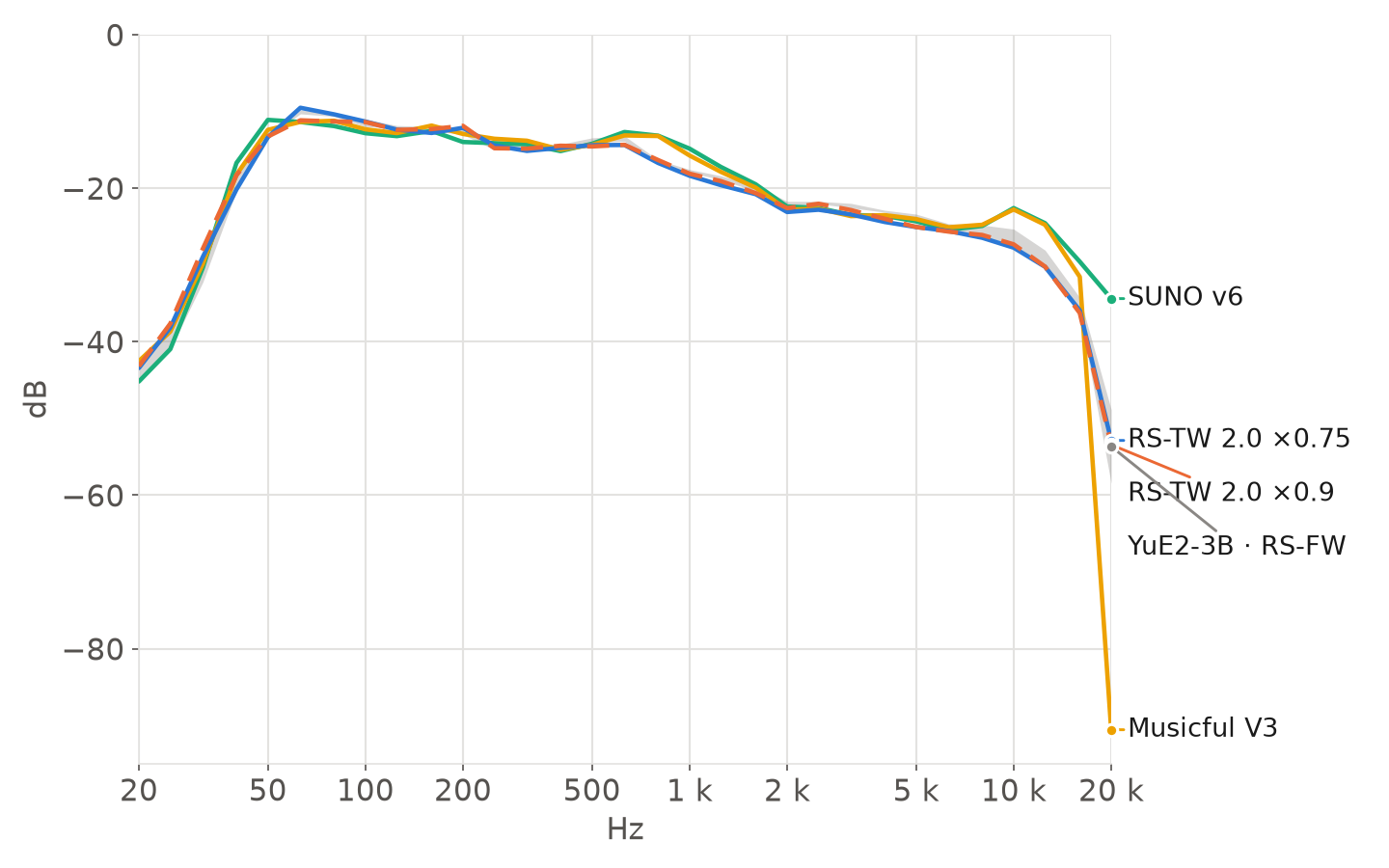
One curve, until the last octave. From 100 Hz to 10 kHz the mean curves of all eight sides stay within 5.2 dB of one another. Above 16 kHz they part. Musicful V3 holds nothing past 16 kHz in 38 of its 40 takes: at 20 kHz its mean lies at −90.6 dB, a wall where the others have a slope. SUNO v6 keeps the most up there, −31.0 dB in 16–20 kHz; ours sit at −39.3 to −42.3 dB, and stop at 16 kHz now and then too, in 1 to 6 takes of 40, most often RS-TW 2.0 ×0.9.
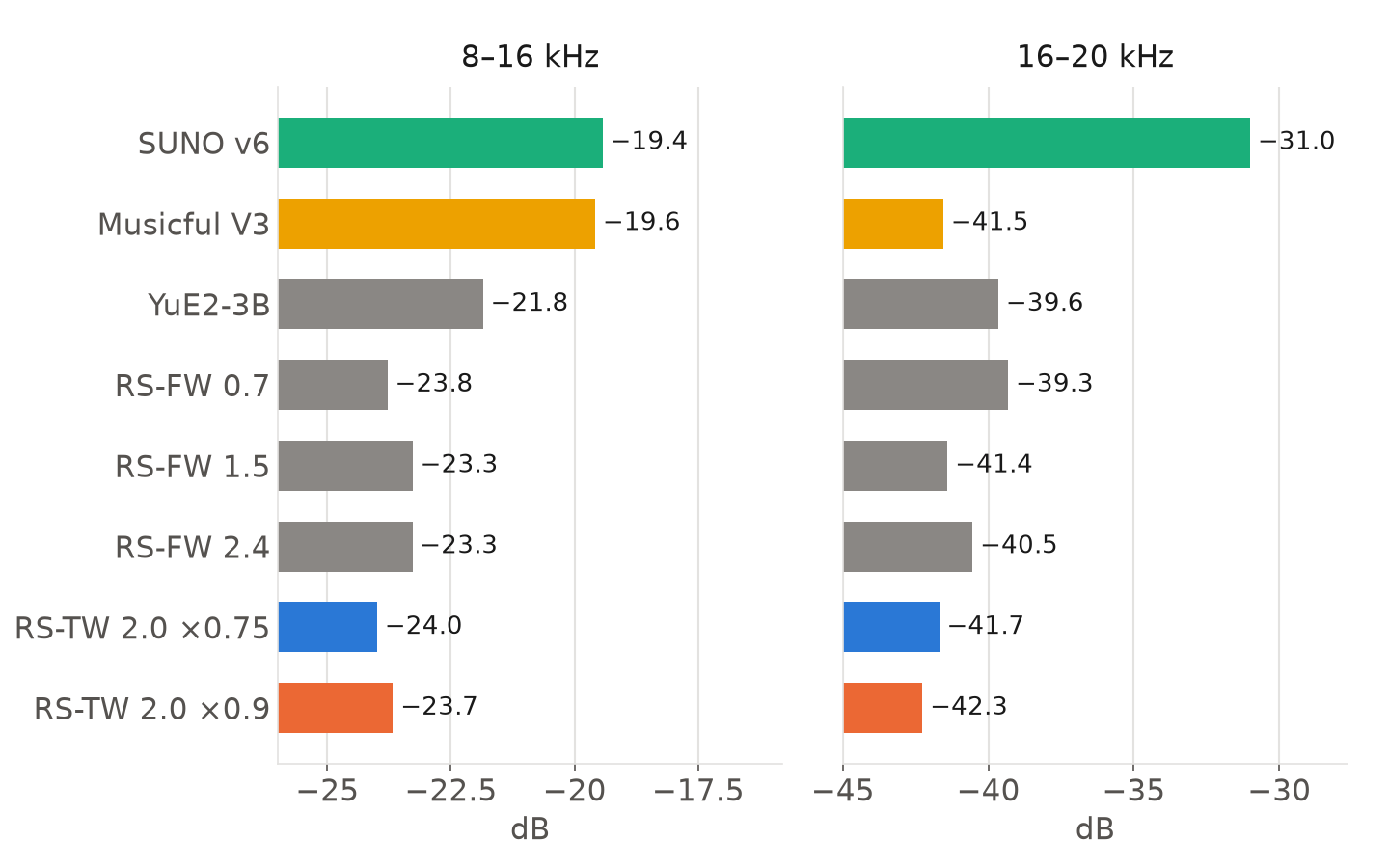
The air: theirs brighter by 2.3 to 4.6 dB. In the air band, 8–16 kHz, SUNO v6 and Musicful V3 sit at −19.4 and −19.6 dB of their takes' power, our six sides at −21.8 to −24.0 dB. A master usually lifts the air, and ours have had none: in Ruach Studio that is the Refiner's to do, once the song is sung.
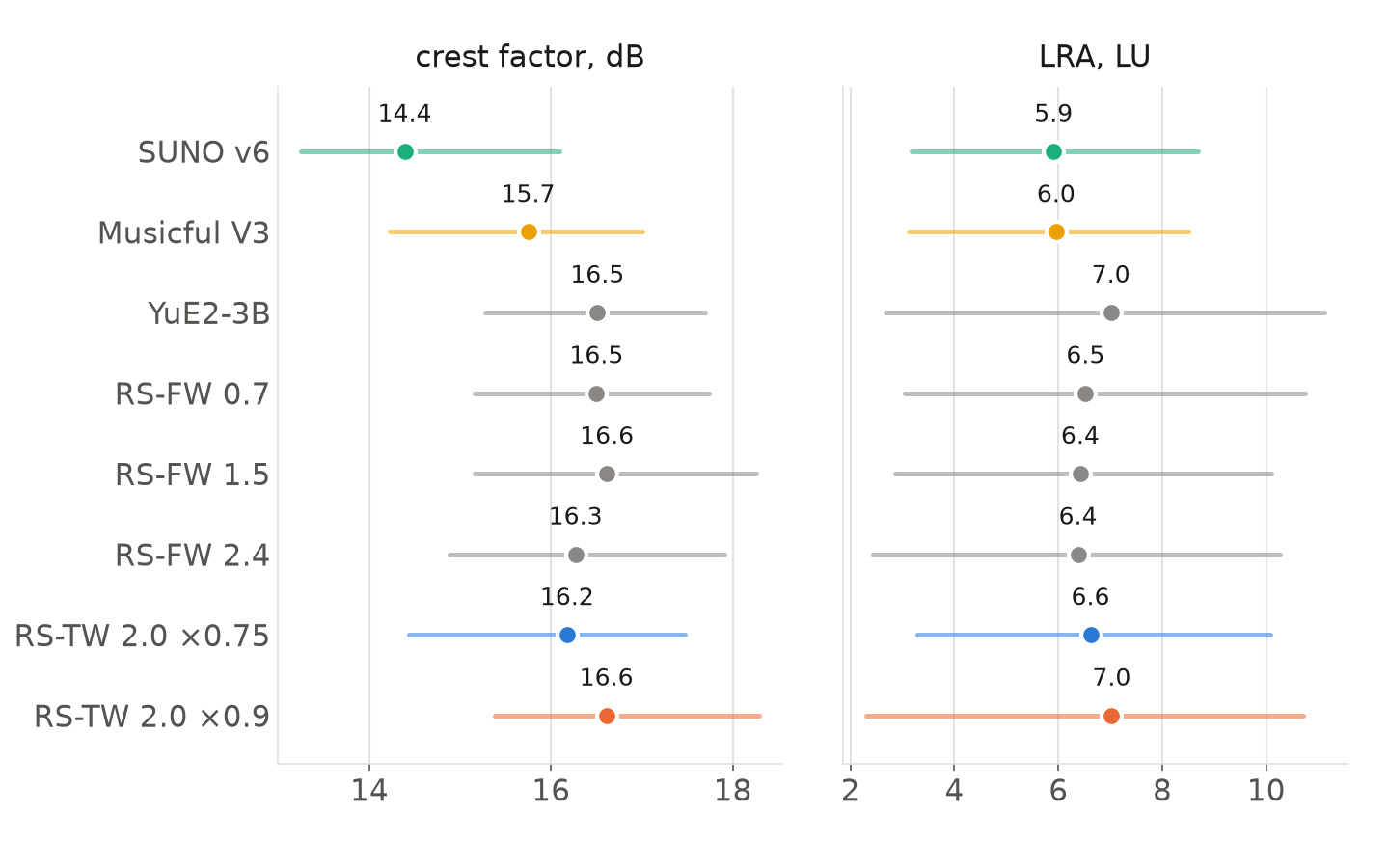
Peaks and range: ours breathe wider. Crest factor, the peak over the average: SUNO v6 14.4 dB, Musicful V3 15.7 dB, ours 16.2 to 16.6 dB. Loudness range: theirs 5.9 and 6.0 LU, ours 6.4 to 7.0 LU. RS-TW 2.0 ×0.9 is the widest of our fine-tunes, 16.6 dB and 7.0 LU, as wide as the stock YuE2-3B (16.5 dB, 7.0 LU): its tectonics, in numbers. ×0.75 is the tighter, 16.2 dB and 6.6 LU.
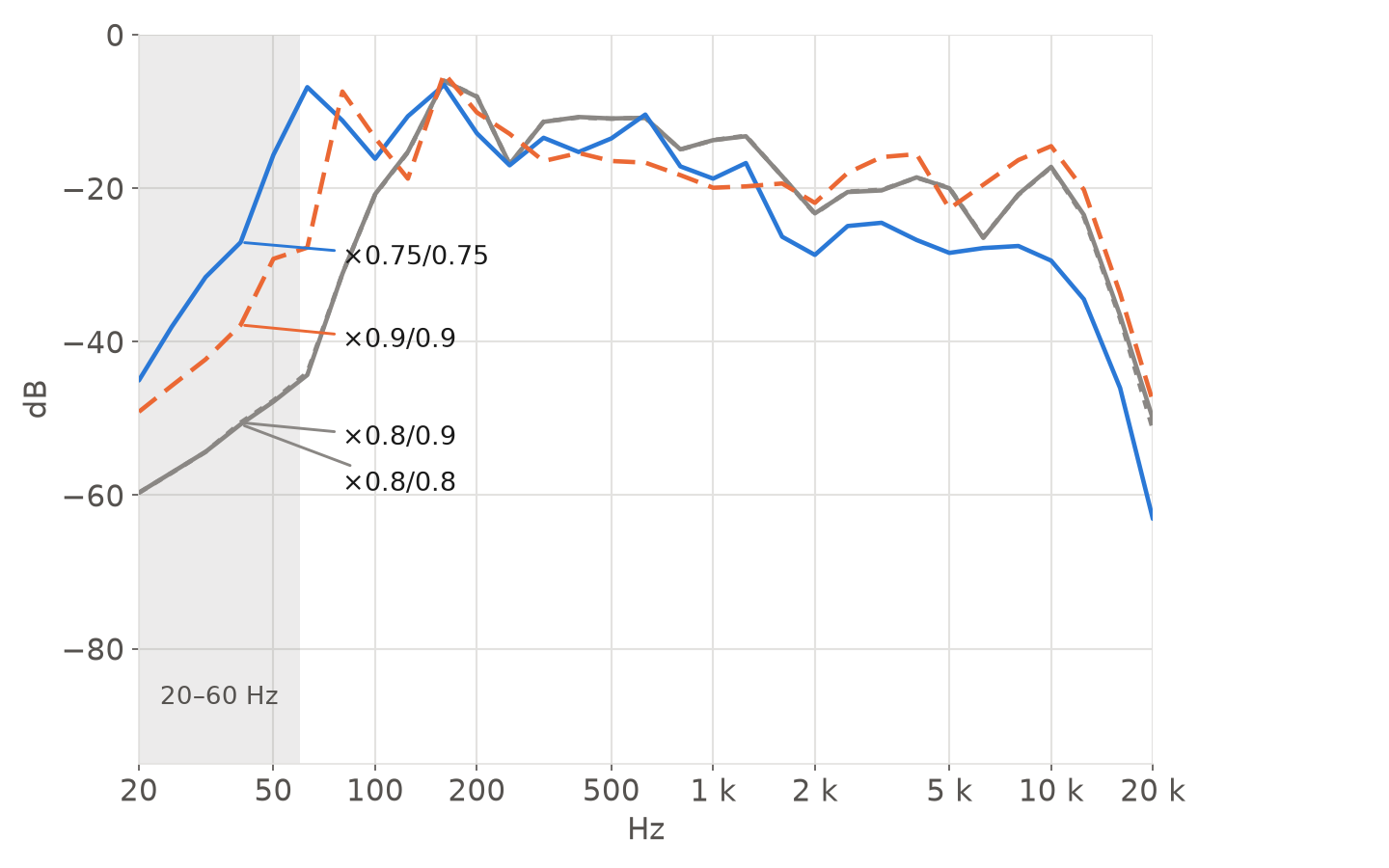
Four strengths, one psalm. The blind set: twelve cards sung at four strengths of the Tsunami Wave over RS-FW 2.4, the same seed at every strength. On Psalm 22 in Greek, the step from ×0.75/0.75 to ×0.8/0.8 took 36 dB out of the sub-bass, 20–60 Hz, from −7.9 to −44.3 dB: the floor went out from under the song. Across the twelve cards the swing is gentler, the sub-bass at −8.5 dB for ×0.75/0.75 and −10.4 to −11.0 dB for the other three, and ×0.75/0.75 comes closest to the ring's own median curve on 6 cards of 12, a mean distance of 4.1 dB against 4.8 to 5.2 dB. That is why ×0.75 becomes Ruach Studio's default in 2.0.6, and ×0.9 the one that promises no stability.
The spectral means of every side, each take at −14 LUFS first (the number of takes beside each name):
| YuE2-3B stock (40) | RS-FW 0.7 (40) | RS-FW 1.5 (40) | RS-FW 2.4 (40) | RS-TW 2.0 ×0.75 (40) | RS-TW 2.0 ×0.9 (40) | SUNO v6 (20) | Musicful V3 (40) | |
|---|---|---|---|---|---|---|---|---|
| tilt 100 Hz–10 kHz, dB/oct | −4.95 | −5.29 | −5.11 | −5.14 | −5.20 | −5.16 | −4.86 | −4.75 |
| air 8–16 kHz, dB of the take's power | −21.8 | −23.8 | −23.3 | −23.3 | −24.0 | −23.7 | −19.4 | −19.6 |
| top 16–20 kHz, dB of the take's power | −39.6 | −39.3 | −41.4 | −40.5 | −41.7 | −42.3 | −31.0 | −41.5 |
| takes that stop at 16 kHz | 3 of 40 | 1 of 40 | 2 of 40 | 2 of 40 | 5 of 40 | 6 of 40 | 0 of 20 | 38 of 40 |
| air in the last third against the first, dB | +1.31 | +0.05 | +0.14 | +0.52 | −0.11 | −0.61 | −0.06 | −0.68 |
| crest factor, dB | 16.5 | 16.5 | 16.6 | 16.3 | 16.2 | 16.6 | 14.4 | 15.7 |
| loudness range, LU | 7.0 | 6.5 | 6.4 | 6.4 | 6.6 | 7.0 | 5.9 | 6.0 |
| low band 20–150 Hz spread p95−p10, dB | 25.3 | 24.0 | 23.2 | 22.2 | 24.8 | 25.4 | 26.5 | 23.0 |
Measured with our own code on the CPU: 1/3-octave bands from a Welch spectrum, loudness and its range by ITU-R BS.1770-4 and EBU Tech 3342. The colours in the graphs: blue RS-TW 2.0 ×0.75 (and ×0.75/0.75), orange ×0.9 (and ×0.9/0.9), green SUNO v6, yellow Musicful V3, grey the sides with no colour of their own (YuE2-3B and RS-FW; on Psalm 22, ×0.8/0.8 and ×0.8/0.9). The same four graphs, by day and by night, with the ring's players: ruachstudio.art/#spectrum.
The same 280 takes, measured for their width. In each of four bands the side, half the difference of the two channels, is set against the mid, half their sum: the higher the side over the mid in dB, the wider that band sounds, and a take in mono would have no side at all. The panorama is how far the difference in level between the left and the right channel swings over a take, from its 5th to its 95th percentile, in dB. Each number is the median of a side's takes. Wider is not better here, only wider: this table has no places and no bold.

| measured raw, the medians | bass 20–200 Hz, dB | mids 0.2–2 kHz, dB | highs 2–8 kHz, dB | air 8–20 kHz, dB | panorama, dB |
|---|---|---|---|---|---|
| SUNO v6 (20) | −12.5 | −7.0 | −6.8 | −9.6 | 6.4 |
| Musicful V3 (20) | −13.0 | −7.2 | −5.9 | −7.9 | 6.6 |
| YuE2-3B stock (40) | −17.4 | −8.2 | −7.9 | −10.6 | 6.4 |
| RS-FW 0.7 (40) | −17.2 | −8.5 | −7.3 | −10.9 | 5.9 |
| RS-FW 1.5 (40) | −17.4 | −7.5 | −6.6 | −10.2 | 6.3 |
| RS-FW 2.4 (40) | −16.5 | −8.0 | −7.9 | −11.2 | 6.4 |
| RS-TW 2.0 ×0.75 (40) | −19.0 | −8.1 | −7.9 | −11.6 | 6.0 |
| RS-TW 2.0 ×0.9 (40) | −20.1 | −8.9 | −8.2 | −12.0 | 5.9 |
Our merges keep the mids and the highs where the stock YuE2-3B has them, none more than 1.3 dB away. RS-TW 2.0 is a little narrower at the edges: ×0.75 by 1.6 dB in the bass, 1.0 dB in the air and 0.4 dB in the panorama, ×0.9 by 2.7, 1.4 and 0.5 dB. SUNO v6 and Musicful V3 open the bass 4.9 and 4.4 dB wider than the stock YuE2-3B. To Viktor's ear the narrower edges of RS-TW 2.0 sound steadier, not like lost stereo: the stock YuE2-3B often parks a guitar in one channel for 15 to 20 seconds.
Measured with our own code on the CPU: a short-time spectrum of 4096 points every 50 ms over the first 240 seconds of each take, the mid and the side as (L+R)/2 and (L−R)/2, the panorama from the difference in level between the channels in 200 Hz – 8 kHz, in the moments within 40 dB of the take's loudest. The colours in the graph: green SUNO v6, yellow Musicful V3, a grey line the stock YuE2-3B, a grey band RS-FW 0.7, 1.5 and 2.4, blue RS-TW 2.0 ×0.75, orange and dashed ×0.9. The same graph by day and by night: ruachstudio.art/#stereo.
The weights derive from YuE2-3B (CC BY-NC 4.0) and from data that includes GTSinger (CC BY-NC-SA 4.0). They are published under CC BY-NC-SA 4.0: non-commercial use, with credit as above, and anything made from them shared under the same terms. LICENSE is that licence; m-a-p's own licence and notices are in licenses/ and THIRD_PARTY_NOTICES.md, copied unchanged.
6-bit
8-bit
16-bit
32-bit
Base model
m-a-p/YuE2-3B